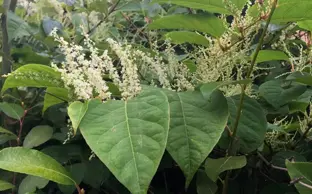
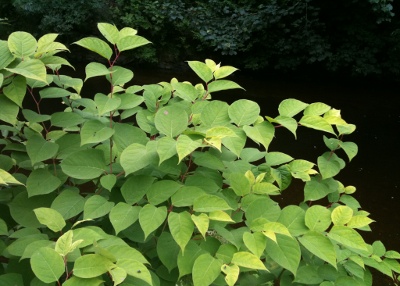
Defra release psyllid to biologically control Japanese knotweed
Last week Defra announced Government approval for the release of a biological agent to control Japanese knotweed. Alaphara itadori is a sap sucking psyllid that feeds on Japanese knotweed in its native range in Japan.
Having submitted a detailed consultation response to Defra last year and having attended a Defra workshop to discuss the proposals, Phlorum remains sceptical of the likely success of the project. There are many reasons why the effect of the psyllid on Japanese knotweed might not be as significant as the press are currently reporting.
The research carried out so far has been with a small population of psyllids on small, immature knotweed plants in small, controlled environment chambers in the laboratory. Results from these experiments on the actual efficacy of the psyllid on knotweed are mainly anecdotal, unpublished and not peer-reviewed. There has apparently been no research on how the ecology of knotweed in the UK differs from that in its native range, which could significantly alter the relationship between Japanese knotweed and the psyllid. The lifecycle of the psyllid in the UK is also not understood. It is believed that it might overwinter on coniferous trees, but this has not been tested.
Possibly to appease knotweed contractors worried that the psyllid might put them out of business, Defra has also been keen to point out that the psyllid will make herbicide applications on Japanese knotweed more effective, but no detailed work has been undertaken to test this.
It is hoped that the questions raised above will be answered by ongoing research in the field. However, we believe that many answers could have been found with more research in the laboratory, well before the risks of releasing an alien species into the wild were accepted. It has been suggested that the release might have been brought forward due to the laboratory population of psyllids being weakened by successive generations of inbreeding. If this is so, it suggests that the risk of releasing the psyllid into the wild was accepted with unacceptable haste.
We await, with interest, the results of this new phase of the research.
Tags: Alaphara itadori, bio control, biological control, Defra, Japanese knotweed, knotweed, psyllid


June 22nd, 2011 at 9:39 pm
I have read your article with interest and hope the day will come that the psyllids you are experimenting with a view to the eradicaion of Japanese Knotweed soon materialises. We have a terrible problem with the weed in my daughters garden in Woking, it is creeping closer to the house and we fear it could come up through the concrete in the kichen area.
This knotweed problem is near a rail line and although the rail authorities killed the weed off a couple of years ago, it is back worse that ever.
If you do release the psyllids into the environment is it possible that they will eventually find their way to others areas of the UK, such as where we live with this problem.
Jane Squires
June 23rd, 2011 at 8:49 am
Biological control could indeed be an effective solution for keeping knotweed in check. However, it will not eradicate it. The best case scenario is that the psyllid will graze on knotweed plants, stunting their growth a bit and possibly making them more vulnerable to attack by other insects, diseases and herbicide applications.
In any case, we could be some way from a time when Aphalara itadori covers large parts of the UK; field trials are still on going and the insect will not spread far on its own when/if it is eventually released on a wider scale.
If the knotweed affecting your daughter’s house has arisen from adjacent land, then there could be a legal case for you to get the growth treated by the adjacent landowner. Call or email us if you would like to discuss this.
January 19th, 2012 at 1:21 pm
[color=grey][size=14]Вопрос, который также является актуальным как пользоваться этим меню в течение дня, если у вас активная работа, которая предполагает постоянное перемещение? Дневной рацион включает в себяблюд для пятиразового питания.[/size][/color]
В грамотно написанном бизнес плане учтены все аспекты и нюансы деятельности будущей фирмы: список рекламных действий, план продаж, учет финансов, система управления персоналом и многое другое. [url=http://www.domovennok.tk/page_186.html]Доставка продуктов домой[/url] Также хорошо давать ребенку добавки с кальцием, кальций полезен для костей и зубов, а магний поддерживает нервную и мышечную системы.
И главное в том, что это действительно экологически чистое мясо, выращенное в естественных природных условиях. [url=http://www.domovennok.tk/page_2.html]Бесплатная доставка продуктов[/url]
И если вы заметили первые признаки увядания кожи, покрывающейся на бедрах и ягодицах так называемой апельсиновой корочкой, немедленно посетите косметологический салон и пройдите антицеллюлитный баночный массаж. ;Вики; производитель кетчупов, майонезов, горчицы и с официальный сайт компании чп «вики», которая является производителем кетчупа, майонеза, горчицы и томатных соусов сгода. [url=http://www.domovennok.tk/page_15.html]Доставка продуктов на дом казань[/url]
Напомним, октября рано утром на улице малышева была сбита летняя студентка третьего курса лесотехнического университета, переходившая дорогу в неположенном месте.