Phlorum in Egypt

August 31st, 2010

Momentum and excitement is building on the launch of our Life-cycle carbon footprinting design tool. Anthony is heading to Cairo in September to present the model at the Conference of Non-Conventional Materials and Technologies (NOCMAT) 2010. The paper to be presented, ‘Accounting for the life-cycle carbon emissions of new dwellings in the UK’, will then be included in the conference proceedings.

The NOCMAT conference aims to provide an international forum for information dissemination, discussions and debates on research and practice in a range of sustainable and innovative construction materials and technologies. The aim is to exhibit the model on an international stage to aid in validation, and take suggestions on improvement from academics and professionals in construction from all over the world.

Phlorum in France

July 9th, 2010

Last Saturday morning, Phlorum staff set out for a lovely weekend in France, courtesy of Jane and her husband Ron. We had to set off very early to catch the ferry from Dover to Calais, so not much sleep was had by all. By the time we got the hang of driving on the wrong side of the road and going around roundabouts the wrong way, we were almost there!

DSCF4250

Ron and Jane showed us the sights and some local bars and we got back to the house just in time for Paul to arrive in the early evening. Paul set off on Friday night by Bicycle from Newhaven, camped outside Dieppe and started pedalling early on Saturday morning; a good 70 miles! He was a bit worn out and damp, but seemed to have enjoyed it all the same! He arrived just in time for a spectacular French feast and lots of wine which I am sure made him feel a lot better.

After being thoroughly spoiled and having a fabulous time (and no doubt with the trousers a bit tighter that previously), it was time to set off for Old Blighty again on the Sunday afternoon, via the cheese and wine shop of course (Paul left early in the morning as he was pedalling again!!).

Simon

Never a loan with Japanese knotweed

July 9th, 2010


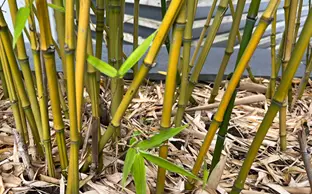
Japanese knotweed canes in winter

Japanese knotweed canes in winter

It seems an unlikely scenario but weeds can stop you getting a mortgage, or so it seems from an article in the Metro last month.

Dave Williams from Cornwall has tried to borrow £83,000 from Santander but has been turned down because of a small amount of Japanese knotweed on a piece of land that he bought recently to extend his garden. Although Mr Williams believes that had this been winter the surveyor would not have noticed, it is likely a diligent surveyor would have seen the dead canes that are evident in the winter.

He could treat the knotweed with a suitable weed killer and eventually it will die with perserverance. Patience is the key; do not be tempted to cut it back or dig it up as the roots will spread even without any leaf.  If there is no building work  planned on the area, it doesn’t have to be a big problem.

However, if Mr Williams is thinking of developing his garden, then he has a problem as Japanese knotweed can grow through concrete and tarmac. Currently, throughout the British Isles, it  is causing the construction industry substantial financial concerns running into millions of pounds in costs to eradicate the dreaded weed.

Jane

Japanese Knotweed Crumble Recipe

April 20th, 2010
Japanese knotweed crumble

Japanese knotweed crumble

Ingredients

500g young knotweed shoots, including leafy “spears”, lower sections peeled, sliced into 8cm pieces
50ml water
100g caster sugar
200g plain flour, sifted
100g cold butter, cubed
125g brown sugar

Method

Place knotweed pieces into a 1.5l oven-proof dish. Pour over the water and sprinkle with the caster sugar.

To make the crumble, blend together the cold butter cubes, brown sugar and flour until it makes an evenly granular mixture. Spoon this over the top of the knotweed pieces so that it is completely covered.

Place the dish in an oven at 180 Celsius and cook for 30mins.

Serve with cream, custard or ice-cream.

You can eat Japanese Knotweed? Wok, are you sure?

April 19th, 2010

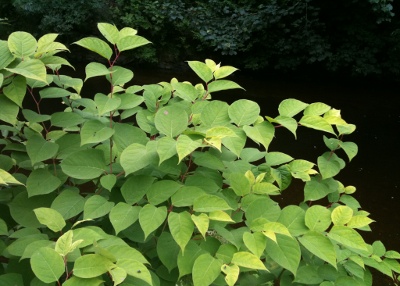
Nettle has a new rival on the edible-weed front; Japanese knotweed, often regarded as a problem plant, has proved itself to be quite a culinary treat according to Phlorum’s Edible Japanese Knotweed Campaign in association with Brighton’s vegetarian restaurant Terre à Terre. So before you start to exterminate the plant’s, smooth, heart-shaped leaves and youthful purple streaked bamboo-like stems, consider eating away your Japanese knotweed troubles!

On a recent BBC Sussex radio appearance for the campaign, Dr. Paul Beckett claimed that if Japanese knotweed is brought under control by recently approved field trials to release a knotweed-sucking insect called Aphalara itadori then ”why not use it the same way people use other pot herbs and other native vegetation to cook with?“

Listen to the Show…
Paul Beckett on BBC Sussex knotweed

The inspiration for Phlorum’s knotweed eating campaign initially arose from the inspirational work of Bun Lai, the chef and owner of Mia Sushi restaurant

who has made incredible dishes with the plant and the sharing of imaginative recipes through social networks and shared with us by Kazuyoshi Nomachi http://twitter.com/im_yutaka

Described with a flavour between asparagus and rhubarb, Japanese knotweed shoots are ready for providing a delightful tang and riveting crunch around late spring each year. Best eaten when the plant is around 6 to 8 inches tall, the knotweed can be transformed via various cooking methods such as steaming, and simmering into delicious dishes such as soups, sauces, fruit compotes and even jam. Although the plants leaves should be discarded, the rind surrounding the stalk of the knotweed can also be used to make a delightful tangy marmalade. Furthermore, besides being a delicious ingredient for cooking, Japanese knotweed provides an excellent source of vitamin A and C, along with its cofactor, the antioxidant rutin.

The plant interestingly also contains potassium, phosphorus and zinc providing the components for a very healthy ingredient.

Following Phlorum’s recent BBC radio appearance, the Japanese knotweed professionals have also been working with the award-winning Brighton-based vegetarian restaurant Terre à Terre (http://www.terreaterre.co.uk/), in order to stir up some delicious recipes with the plant.

The team at Terre a Terre Brighton

This collaboration will also be available for viewers to watch as on Wednesday the 21st of April, a BBC South film crew will be visiting Olivia, Terre à Terre’s Events, Marketing and Design Manager in order to film Japanese knotweed delights being prepared in the kitchen and then tasted at the restaurant. Along with a TV appearance, Phlorum will also be making a further radio appearance on the same day on BBC Sussex Radio station in order to take part in the breakfast show recording of Japanese knotweed being consumed live on air with the breakfast show host, Neil Pringle.

Lifecycle Carbon Footprinting Model at Ecobuild

April 15th, 2010

Phlorum won a competition to display their Life-Cycle Carbon Footprinting model in the Innovation Future Zone at Ecobuild last month.

The project was deemed one of 20 innovations most likely to have a large impact on the environmental future of the construction industry, chosen from those who applied for the position to CIRIA. Anthony stood by the model for three long days explaining the rationale behind the method, and the potential of the model in reducing embodied carbon emissions. Such emissions will account for 100% of total emissions associated with a dwelling come 2016, when all new-build homes are expected to be zero-carbon. Through testing of scenarios, it was found that a dwelling built with environmentally friendly yet common materials (such as sustainably sourced timber) could attain a ‘zero-carbon footprint’ after 50 years with the aid of renewable technologies such as a biomass boiler and photovoltaic panels.

The event was a success, with many representatives of organisations displaying their interest in the final product, which is expected to be launched at the end of 2010. The video shows Anthony discussing the functionality of the model with an interested party.

Japanese Knotweed found on Mars!

April 1st, 2010

Martian Japanese knotweed

Martian Japanese knotweed

Japanese knotweed on Mars

Just confirmed by NASA, who are still sifting through samples beamed back to Earth from the Mars Rover, remnants of Japanese knotweed rhizome have been found on the red planet! Shocking news as scientists are still debating whether or not there is, or ever was, life on Mars! This could indicate that the invasive Japanese knotweed on our blue planet really is an alien and this could explain why it is so difficult to understand and destroy!

More news on this exciting discovery as it breaks!

Phlorum paper published in the Environmentalist

March 19th, 2010
Victorian Homes are the hardest to eco-refurbish

Victorian Homes are the hardest to eco-refurbish

Phlorum has had a paper published in the March edition of the Environmentalist, the magazine sent to all 14,000 members of the Institute of Environmental Management and Assessment (IEMA). The paper was written by Anthony Probert and is entitled ‘Tenant Participation in the Sustainable Refurbishment of Victorian Properties’. Anthony carried out the research whilst studying for his MSc, and concludes that whilst the idea of tenant participation is conducive to achieving widespread sustainable refurbishment of hard-to-treat homes, tenants’ lack of desire to participate has been fuelled by disappointment in previous landlord initiatives.

A copy of the paper can be downloaded by IEMA members from the IEMA website. Those interested who are not IEMA members can obtain a copy by emailing us at info@phlorum.com.

Leadership training course by Bowles

March 18th, 2010
Image and video hosting by TinyPic

Bowles Leadership Training Course

Phlorum staff recently attended a leadership training course at the Bowles outdoor centre near Tunbridge Wells.

Defra release psyllid to biologically control Japanese knotweed

March 18th, 2010
Japanese knotweed bio-control agent

Japanese knotweed bio-control agent

Last week Defra announced Government approval for the release of a biological agent to control Japanese knotweed. Alaphara itadori is a sap sucking psyllid that feeds on Japanese knotweed in its native range in Japan.

Having submitted a detailed consultation response to Defra last year and having attended a Defra workshop to discuss the proposals, Phlorum remains sceptical of the likely success of the project. There are many reasons why the effect of the psyllid on Japanese knotweed might not be as significant as the press are currently reporting.

The research carried out so far has been with a small population of psyllids on small, immature knotweed plants in small, controlled environment chambers in the laboratory. Results from these experiments on the actual efficacy of the psyllid on knotweed are mainly anecdotal, unpublished and not peer-reviewed. There has apparently been no research on how the ecology of knotweed in the UK differs from that in its native range, which could significantly alter the relationship between Japanese knotweed and the psyllid. The lifecycle of the psyllid in the UK is also not understood. It is believed that it might overwinter on coniferous trees, but this has not been tested.

Possibly to appease knotweed contractors worried that the psyllid might put them out of business, Defra has also been keen to point out that the psyllid will make herbicide applications on Japanese knotweed more effective, but no detailed work has been undertaken to test this.

It is hoped that the questions raised above will be answered by ongoing research in the field. However, we believe that many answers could have been found with more research in the laboratory, well before the risks of releasing an alien species into the wild were accepted. It has been suggested that the release might have been brought forward due to the laboratory population of psyllids being weakened by successive generations of inbreeding. If this is so, it suggests that the risk of releasing the psyllid into the wild was accepted with unacceptable haste.

We await, with interest, the results of this new phase of the research.