«Back to Air Quality Strategy

Road Traffic Emissions

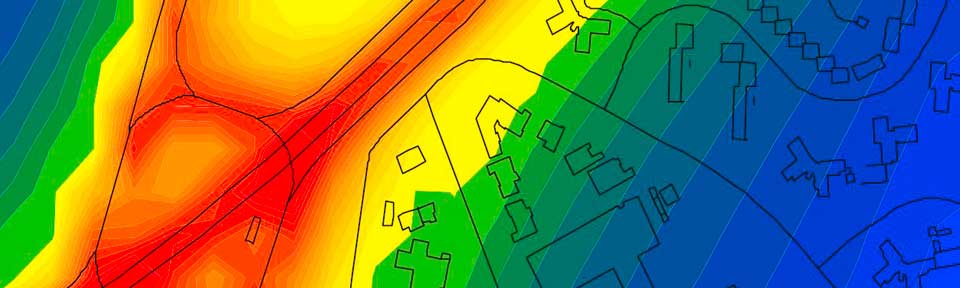
Emissions from road traffic are the most significant reason for the declaration of AQMAs by local authorities across the UK. This is most usually due to housing being located close to roads in many urban areas. For this reason, air quality issues can be a material consideration during the planning process. It is therefore often a requirement of the local planning authority that an air quality assessment should be undertaken for any development that proposes to either introduce sensitive receptors or to generate traffic to areas where air quality is a concern.

There are a variety of assessment tools that Phlorum Limited use to assess the impacts on and sensitivities to various development proposals. These include screening tools developed from empirical relationships between traffic volume and distance of sensitive receptors from busy roads (e.g. Defra's DMRB model), to more complex computational dispersion models requiring detailed meteorological data as an input (e.g. Breeze Roads).

Typical projects that Phlorum Limited has provided air quality assessments for include: comparisons of proposed road scheme routes; residential developments; large commercial buildings; industrial estates; retail developments; and bus depots.

Industrial Emissions

Many industrial processes emit pollution to the atmosphere. Commonly, this is in the form of waste gasses from combustion sources that are dispersed into the atmosphere via a tall chimney or stack (e.g. emissions from gas and coal fired power generation). However, there are many other industrial sources of waste gases and fine particulate material that can pollute the atmosphere. Examples of such industries include: fuel refinery and production; metal production and processing; mineral extraction and processes; chemical industry; waste management, treatment, transfer and storage; paper, pulp, board and textile industries; and tar and bitumen activities.

In addition to stack emissions from definable "point" sources, airborne pollutants from processes associated with these industries can arise from volume (e.g. plumes of dust from elevated conveyor systems in quarries), area (e.g. methane emissions from the surface of a landfill site) or line sources (e.g. emissions from a moving diesel powered locomotive).

Depending on the scale of emissions from an industrial process it is either regulated by the local authority for smaller processes and the Environment Agency for much larger sources.

Using a variety of tools and assessment methodologies, which usually require significant scoping and liaison with appropriate regulators, Phlorum Limited routinely provides air quality consultancy services for environmental permitting and/or planning applications for a wide range of industrial processes.

Construction Emissions

Demolition, remediation, site preparation and construction are phases that are easily overlooked during a development programme, as they generally represent a fraction of a scheme's lifecycle. However, if the potential effects on air quality of these phases are not effectively assessed and mitigated, then they can cause highly significant local effects. For the majority of construction projects, emissions of dust are the greatest concern in terms of air quality impacts. However, emissions of toxic gasses, vapours and fine particulate matter can also be significant, particularly on contaminated, brownfield sites. Consideration of construction phase effects is also a requirement of the Environmental Impact Assessment Regulations. It is therefore often necessary to assess, model, predict and/or monitor emissions to the atmosphere during the phases of a development project before it is occupied and becomes operational. In addition to the models and assessment tools used for industrial and vehicular emissions, Phlorum Limited has the capability to provide these additional air quality assessment services for these development projects.

Odour Assessments

Odour is a complicated parameter to measure and much research has been conducted into developing monitoring equipment to replicate this highly complex human sense. The main difficulties in monitoring odours are that there are wide variations in the sensitivities and perception of people to different odours and most odours are made up of a complex mixture of different compounds. Additionally, the concentrations at which some odours are detected are very low and the periods over which they can be experienced as being offensive can occur intermittently over just a few seconds, which can make collecting samples and analysing them very difficult. Often the best monitoring equipment for determining the strength, character and offensiveness of an odour is the human nose. This can be via an individual assessor in the field, a panel of "calibrated" assessors, or in a laboratory environment with a field sample using an item of equipment called an olfactometer.

For the same reasons that monitoring odours can be difficult, accurately predicting odour concentrations from a proposed source such as a new restaurant or sewage treatment plant can also be very difficult. However, dispersion models and other assessment techniques are recognised by regulators to provide useful information for determining planning applications and environmental permits.

Phlorum Limited is experienced in providing the full range of odour consultancy services. We are routinely appointed to provide monitoring and assessments for proposed facilities and for determining or refuting nuisance complaints from existing processes.

Health & Safety

The Health and Safety Executive provides detailed guidance and statutory limits on the exposure of workers to airborne pollutants. This includes many highly toxic compounds like carbon monoxide and cyanide as well as less obvious pollutants, like dust, which can cause adverse health impacts.

At Phlorum Limited we can provide the monitoring equipment and analysis of results that allow employers to comply with the law and protect their staff from occupational exposure to potentially damaging air pollutants. This often involves equipping staff with personal air sampling equipment at their workplace and monitoring them over an eight hour working period.

air quality data sheet


Our Clients

Click here to view a small selection of clients we have worked with past & present.
Go

Testimonials

Find out what our clients think about our services.
Go

Case Studies

View information on a selection of our case studies.
Go

Contact Us - Head Office
t: +44 (0) 1273 7044 49
f: +44 (0) 1273 7044 99
e:
Go