
Case Study
Starnes plc
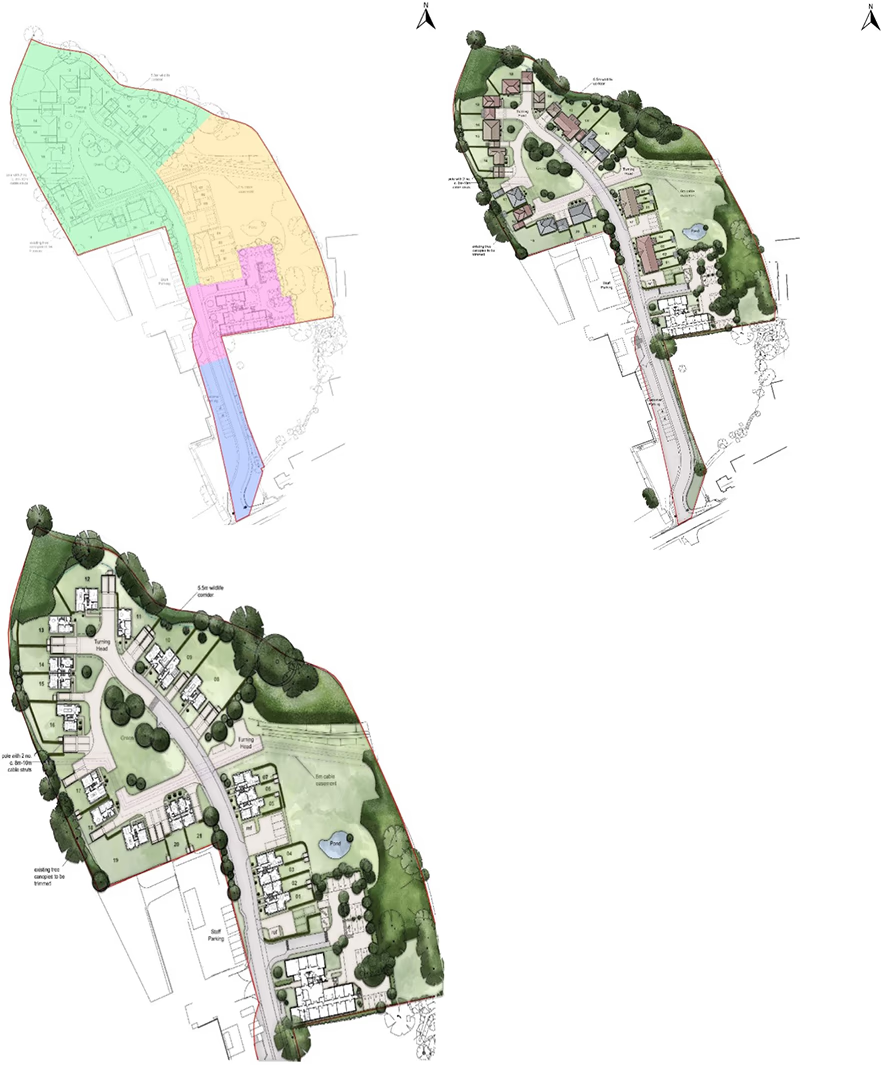
Phlorum was commissioned by Starnes plc to undertake an air quality assessment to support a planning application for a small-scale, mixed-use development on a site at Land North of Station Road, Robertsbridge, East Sussex.
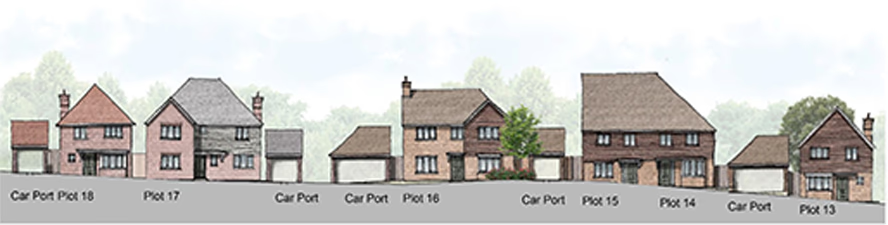
The development comprises 21 semi-detached residential dwellings and a doctor’s surgery, together with car and bicycle parking bays and landscaping, including the provision and preservation of greenspace at the site.
Starnes plc is a small team of chartered surveyors and accountants with a wealth of experience in providing premium and bespoke commercial and residential development.
The site is located within the rural village of Robertsbridge, within Rother District Council’s administrative area. The area surrounding the site largely comprises sensitive residential uses, agricultural uses and greenspaces.
The Challenge
At the time of undertaking the Air Quality Assessment, the Proposed Development had been granted planning permission (Planning Reference No. RR/2023/27/P & RR/2025/1069/P), pursuant to a number of planning conditions, including Condition 4, requiring an Air Quality Assessment.
The Air Quality Assessment was required to establish the air quality impacts and the suitability of the site, with regards to the construction and operational phases associated with the Proposed Development, in line with relevant local and national guidance and policies. As the site is located within East Sussex, the wider Air Quality Assessment was required to include an assessment of the incremental cumulative impacts of the Proposed Development on local air quality, known as an Emissions Mitigation Assessment.
Starnes plc recognised that they would be required to provide evidence of the suitability of the site for its proposed use, as well as determining the Proposed Development’s impact on local air quality and ensuring that mitigation measures would sufficiently offset any cumulative local air quality effects. Phlorum was instructed to meet these requirements by undertaking an Air Quality Assessment in support of Starnes plc’s planning application. In doing this, the requirements of planning condition 4 were met and the development was permitted.
The Services Provided
Phlorum produced a comprehensive Air Quality Assessment to support the planning submission, which included a review of local and national environmental policy and air quality data and the assessment of construction-phase and operational-phase impacts and exposure. An Emissions Mitigation Assessment, to determine the ‘damage cost’, in monetary terms, of the scheme’s operational emissions and the associated mitigation package that would be required to offset the ‘damage cost’ was also undertaken in accordance with relevant Sussex air quality guidance.
Phlorum maintained regular communication with Starnes plc and the project’s collaborative team of consultants on matters relevant to the air quality study, such as the Proposed Development’s anticipated traffic generation, scheme design information, construction programme and methods, and operational-phase mitigation proposals.
Unlike large-scale developments, small-scale developments, which do not generate significant amounts of traffic or building emissions, are not typically required to provide detailed dispersion modelling assessment to support planning applications. Instead, the requirement for further assessment of the suitability of the site can be established using local and national air quality monitoring and background pollutant modelling data, and the impacts on local air quality can be assessed based on traffic generation and building emission criteria, thus scoping out any potentially significant air quality risks on existing or proposed receptors.
The Proposed Development’s mitigation package, to be provided alongside the development, included an all-electric scheme to meet the Proposed Development’s energy demand and several measure to further mitigate the Proposed Development’s anticipated traffic emission generation, such as the provision of electric vehicle charging infrastructure, cycle storage and the provision of other infrastructure and resources to encourage sustainable transport.

The Outcome
Following the submission of the Air Quality Assessment in October 2024, a Senior Environmental Health Officer for Rother District Council and Wealden District Council confirmed their satisfaction with the air quality assessment’s conclusions, including the justifications used to determine that the Proposed Development’s mitigation package was suitable for the small-scale scheme being proposed.
The Proposed Development has since been permitted and is projected to begin development before the end of 2027. Phlorum will provide any post-planning air quality support that may be required as the project moving forwards, such as construction dust management and monitoring expertise.
Phlorum’s air quality consultants regularly undertake air quality assessments to support planning applications for land development projects in the south-east of England and elsewhere in the UK.