Call us free on 0808 168 9540
Call us free on 0808 168 9540
Phlorum is an award-winning PCA-accredited Japanese knotweed contractor providing Japanese knotweed services to domestic and commercial clients in Sussex, London, Surrey and Kent.
We provide Japanese knotweed removal services using the latest science and technology to deliver effective solutions to our clients, with meticulous service. We employ a variety of Japanese knotweed treatment methods, often used in combination, to ensure the safe and efficient removal of knotweed from any property or premises.
We offer fully accredited and practical solutions for a wide range of clients, from small domestic properties to large-scale commercial premises. Our knotweed experts are regularly called upon as Japanese knotweed expert witnesses and have been involved in significant, landmark, precedent-setting cases that have steered Japanese knotweed legislation.
When hiring us for our range of Japanese knotweed services, you can be confident that you are appointing a team of expert Japanese knotweed specialists who are passionate about delivering the highest levels of service and complete eradication of knotweed.




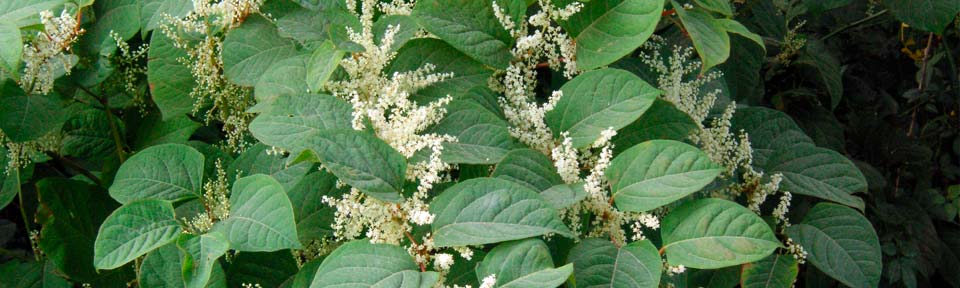
Japanese knotweed has been described as the most invasive alien species in Britain, first being introduced to the UK in the mid-1800s. It is prevalent across the entire British Isles and is often found on brownfield and wasteland sites. Its presence can have devastating consequences if not dealt with promptly, including legal implications and high removal costs of Japanese knotweed.
Identifying Japanese knotweed is not always easy. If you suspect that you may have an infestation, then our comprehensive Japanese knotweed identification guide provides clear guidance, or you can consult our guide to plants that are often mistaken for Japanese knotweed.
Our experienced staff are accredited with the PCA’s knotweed survey and contractor qualifications (CSJK), which support our provision of Japanese knotweed surveys for a wide variety of sites and domestic and commercial properties.
Phlorum is a leading Japanese knotweed removal company in the UK with extensive experience in removing Japanese knotweed from both residential and commercial sites. As award-winning PCA-accredited knotweed removal experts, our work is fully guaranteed for 10 years and meticulously carried out on time and to agreed budgets.
Our co-founder, Dr Paul Beckett, is renowned as the UK’s leading authority on Japanese knotweed. He provides Japanese knotweed expert witness services in relation to the risk to property and wider knotweed legislation. He has provided expert evidence in the UK and Irish courts, the Lands Tribunal, the Tax Tribunal and at numerous Public Inquiries.
There are several proven methods for treating Japanese knotweed, each suited to different site conditions, timeframes and costs. Options range from multi-season herbicide programmes, reduced-dig approaches, capping solutions, installation of root barriers and membranes, treatment-bund formation, on-site burial and full excavation with licensed disposal. Each technique offers a different balance of speed, certainty and cost, making a site survey essential for selecting the most appropriate and effective approach.