
Call us free on 0808 168 9540
Call us free on 0808 168 9540
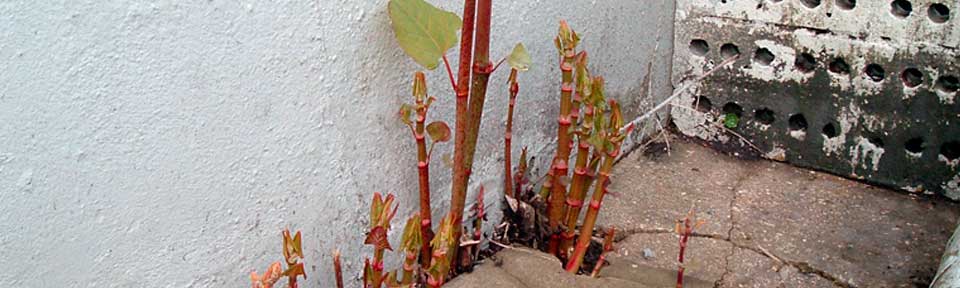
Japanese knotweed is the most invasive species in Britain and poses serious legal, structural and financial risks for both residential and commercial property owners.
This guide explains what Japanese knotweed is, how it spreads and why it has such far-reaching implications for your land or building.
Japanese knotweed is one of Britain’s most invasive plants with a deep-penetrating root system and dense above-ground growth, capable of causing structural damage and complex liability issues. Introduced from East Asia in the nineteenth century, it has proved difficult to control and can spread through tiny fragments of root material.
Historically, Japanese knotweed has had many common names. Some of these are as follows:
Japanese knotweed originally comes from Japan and parts of eastern China, Korea and Taiwan.

Japanese knotweed is widespread in the UK. It favours disturbed sites of marginal land and disused urban spaces. It can also be prevalent along old railway lines and waterways.
Japanese knotweed was first introduced to Kew Gardens in the mid-1800s by a Bavarian physician, Philipp von Seibold, who had a side interest in botany. On returning to Europe from working in Japan, he established an exotic plants nursery in Belgium, where he sold Japanese knotweed at extortionate prices to Victorian gardeners in Britain.
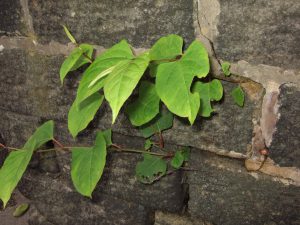
Japanese knotweed is an invasive plant that can spread aggressively outside its natural range in East Asia. It was introduced to the UK in the 1800s and has spread across the country, causing damage to built structures and wild habitats.
Japanese knotweed exhibits vigorous growth through the soil from a fibrous rhizome (creeping root system) that can cause damage to areas of hard standing, foundations, drains, services, walls and other built structures by growing through cracks and openings between them. Soil can be contaminated with reproductive knotweed material up to a depth of 3m and a radius of over 7m.
The Environment Agency had recommended that all soil within these extents should be removed as knotweed-contaminated waste and/or should be treated.
If it is not dealt with before a site is redeveloped, or if groundworks are carried out for another reason, Japanese knotweed-contaminated material can be very easily spread across or off a site, resulting in new areas of knotweed growth and, potentially, criminal prosecution or litigation from third parties.
This is because regeneration can occur from only a small amount (less than a centimetre) of knotweed root (rhizome), forming a new, viable plant.
Like many foreign plants, Japanese knotweed was seen by Victorian gardeners as an unusual and attractive addition to parks and large gardens. Initially, its hardiness and ease of establishment were seen as benefits.
Japanese knotweed is widespread in the UK. However, it is getting less obvious in urban areas as people take steps to control it. On land with little management, it tends to be more evident as large stands scattered over vast areas.
In its native range in Japan knotweed can still be seen as a pest because it can rapidly spread to form dense thickets where it is not wanted and it remains difficult to control.
Japanese knotweed forms dense, bamboo-like thickets that can grow up to 3m tall. Its thick stems are green with mottled red spots. Its leaves are shield-shaped, with flattened bases. It produces spikes of small white flowers very late in the growing season, around September.
If allowed to accumulate and grow over many years, the roots and rhizomes of Japanese knotweed can grow through gaps in built structures and floors, prising them apart and causing damage as the rhizomes expand and develop into large crowns. Damage can also be caused to drains and sewers, as Japanese knotweed rhizomes can grow many metres through them, seeking out gaps and cracks to penetrate and emerge from.
Japanese knotweed is not poisonous or otherwise harmful to humans. In fact, many parts of the plants can be eaten or have been used in traditional or alternative therapies and medicines. The only real risk of harm likely to be caused by Japanese knotweed is if its accumulated growth causes a heavily built structure, like a wall, to fall over.
Japanese knotweed has been used for centuries in some societies as a herbal medicine. While many of the health claims from ingesting or applying Japanese knotweed remedies are scientifically unproven, the plants do contain high concentrations of the antioxidant resveratrol, which is also found in red grapes.
Japanese knotweed has also been used as a cooking ingredient, finding its way into many recipes in its native range. The flavour is similar to rhubarb, and thus it makes tasty pies, drinks and chutneys.
It is not illegal to have Japanese knotweed growing on your property. However, in the UK, some laws make it a criminal offence to plant Japanese knotweed or to cause it to grow in the wild.
Numerous precedents in civil law enable those affected by Japanese knotweed to take legal action to recover costs and damages from those who were responsible for causing the knotweed to spread.
In the UK, Japanese knotweed almost exclusively grows vegetatively from small fragments of its underground shoots (rhizomes) or, less readily, from pieces of stem.
It almost never grows from seed. However, in other parts of Europe and North America, seedlings are more prevalent. New stems emerge from the ground in early spring, either from large buds on the crowns or from small buds that develop underground on the rhizomes. The curled red leaves and shoots quickly unfurl, and by early summer, they develop into thickets of tall canes with dense foliage.
Flowers appear late in the summer, providing an essential source of nectar for pollinators. The leaves and stems die back in winter, ending the annual cycle of growth.
If you find Japanese knotweed on your land, then you should talk to a professional to help you understand how it might affect you and what the costs might be to effectively treat it.
Japanese knotweed leaves have long been used as livestock fodder, with horses reportedly being particularly partial to them. More recently, goats have been used to graze Japanese knotweed infestations to manage them.
This won’t kill the knotweed, but it will stop it from growing out of control. Although there are no reports of it harming animals, Japanese knotweed contains high levels of oxalate (as do rhubarb and spinach), which can upset the digestion of livestock.
Many people have attempted to remove Japanese knotweed themselves, with varying degrees of success. However, if land that might require mortgage finance is affected by knotweed, it will usually require assurances and guarantees available only through professional treatment.
It is not easy to get rid of Japanese knotweed. Its roots and rhizomes can grow very deep into the ground and spread several metres laterally beyond the stems. This presents an iceberg analogy: there is often a much larger biomass below ground than above ground.
This means that herbicides applied to the leaves often don’t reach the roots, making herbicide control difficult and potentially taking many years. Another method to get rid of Japanese knotweed is to dig it out completely. However, owing to the often large size and extent of the rhizomes, this can require significant effort and result in large volumes of infested soil, which can be very expensive to dispose of.
If you are looking to identify Japanese knotweed, we have a range of resources and a dedicated identification service that can help. If you prefer, send us a picture for your free assessment. We also have a detailed guide to plants that look like Japanese knotweed that are most often mistaken for knotweed.
If you have received confirmation that you have Japanese knotweed, we offer Japanese knotweed surveys for domestic and commercial premises. If you think that you have Japanese Knotweed on your property or construction site, get in touch with our team of experts for your free consultation.